


How to Play the On Drive Like Sachin Tendulkar: Practice at Home
The on drive is a front-foot drive played to a full ball on middle or leg stump and hit along the ground between mid-on and mid-wicket. Sachin Tendulkar is the reference point for the shot. The version fans copy comes down to four things: the head moves toward the line of the ball first, the front foot lands down the line of leg stump, the bat comes straight down from a high backlift, and the ball is met under the eyes with the top hand driving. To practise it at home, the MetaShot Smart Bat lets you take that stance in the living room and face the in-game bowler, with no ball to hit.

Fans copy Tendulkar's on drive because it looks like the shot in the coaching manual: balanced, straight and played along the ground. Coaching sources describe the on drive as one of the most difficult strokes in the game, because it asks for a stride across to the line of the ball, a still head and a straight bat all at once.
One of the earliest moments of the shot is also one of the best known. On 15 November 1989, a 16-year-old Tendulkar made his Test debut for India against Pakistan at the National Stadium in Karachi. His first runs in international cricket came from an elegant on-drive to the boundary, off Waqar Younis, who was also making his debut.
This guide breaks the shot into four stages, explains which balls to drive and which to leave, and shows how to practise it at home with a MetaShot Smart Bat, starting with a short shadow warm-up.
What makes Sachin Tendulkar's on drive stand out
Every coaching manual teaches the same on drive. What stands out in Tendulkar's version is how cleanly the basics fit together, ball after ball.
- A head that leads: the head goes toward the line of the ball first, with the eyes level and the head above the bent front knee.
- A short stride down the line: the front foot lands down the line of leg stump, no wider, so the bat has room to swing through.
- A straight, high backlift: the bat comes down in a straight line rather than across the ball.
- Contact under the eyes: the ball is met under the eyes, with the front elbow pointing toward the target.
- A dominant top hand: the top hand drives the shot and the bottom hand steers it, so the bat face finishes toward mid-on.
- A trademark shot: on the first day of his 200th and final Test at the Wankhede Stadium in 2013, BBC Sport described his on-drive for four as a trademark stroke.
Which ball to on drive, and which to leave
The on drive is only as good as the ball you pick. Use this as a checklist before you commit.
| Length | Full, or a touch overpitched, so one stride takes the front foot to the line of the ball |
| Line | Middle stump and leg stump |
| Bowling | Pace and spin |
| Where it goes | Along the ground, between mid-on and mid-wicket |
| Leave or defend it when | The ball is a good length that your front foot cannot reach with one stride, or it is so wide that you would have to reach for it |
| Play a different shot when | The ball is short and on the leg side: that is a pull, a flick or a leg glance, not a drive |
How to play the on drive step by step
The steps below are for a right-handed batter. Left-handers mirror every step.
1. Stance, grip and backlift
Stand side-on with your feet about shoulder-width apart, knees slightly bent and your weight balanced over the middle of your feet. Hold the bat with both hands close together near the top of the handle, with the left hand on top. Keep your head still and your eyes level, looking at the bowler over your front shoulder.
Lift the bat high and straight as the bowler runs in. A straight backlift makes a straight downswing far easier, and the on drive depends on a bat that comes down in a line.
2. Head first, then the front foot down the line
As the ball is delivered, move your head toward its line before anything else moves. The front foot follows with a short stride that lands down the line of leg stump, no wider. Point the toe of the front foot roughly up the pitch, and bend the front knee so that your head sits above it.
The stride is where many players go wrong. Too long and you lose balance; too wide and the bat has no room to come through the line of the ball. Shorten the step until your head is over the ball, then stop moving forward.
3. Meet the ball under your eyes
Bring the bat down straight, with a high front elbow pointing toward the target. Make contact under your eyes and ahead of your front pad, not out in front of your body and not across it.
Let the top hand do the driving, with the bottom hand steering the bat face toward mid-on. If the bottom hand takes over and pushes, the face closes, the ball loses its line and often goes up in the air.
4. The controlled finish
Let the bat swing through the line of the ball and finish with its face pointing toward mid-on and your hands high. Hold that position for two seconds. If you can hold it without wobbling, your balance was right.
Watch the ball off the bat rather than the finish itself. A good finish is the result of a well-timed drive, so focus on the head, the stride and the bat, and the finish will follow.
How to practise the on drive at home
The practical answer is MetaShot. The MetaShot Smart Bat is a full-size, bat-style controller with motion sensors inside. You take your stance, an in-game bowler delivers on your phone, laptop or TV, and you play your drive at each delivery. The bat gives light and vibration feedback as you play, and there is no ball to hit, so nothing needs fetching between deliveries.
That means you can play a long run of on drives in one session, with the same stance and stride you use in the nets.

Set up in a few minutes
Download the free MetaShot game, turn on Bluetooth on your phone, tablet or laptop, open the app and choose a game mode, then connect the bat. For the big-screen experience, connect your device to the TV with the MetaShot MHL connector supplied with the bat. The Product Setup page has the steps for each device.
An on drive practice session
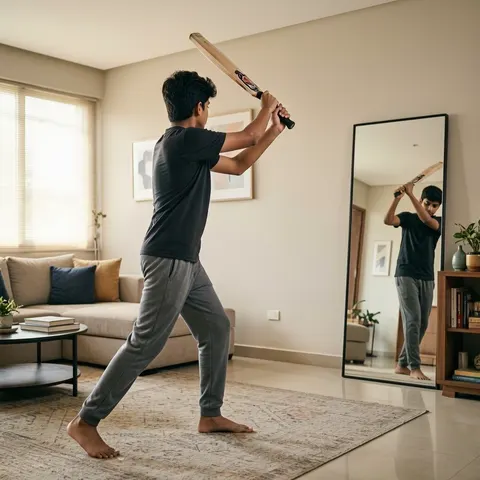
Start with a minute of shadow on drives in front of a mirror, without the bat connected. Check the four stages: head first, front foot down the line, straight bat, high finish. Then pick up the MetaShot Smart Bat and take the same shape into the game.
| Part of the session | What to do | Focus |
|---|---|---|
| Warm-up | Shadow on drives in front of a mirror | Head first, front foot down the line |
| Practice mode | Face the in-game bowler and drive the full balls on middle and leg | Timing: meet the ball late, under the eyes |
| Hold the finish | After every drive, freeze in the finish for two seconds | Balance through the shot |
| Match play | Switch to a multiplayer or tournament game against friends or family | Choosing which balls to drive when runs matter |
MetaShot's practice modes are built for working on timing and shots, so spend most of the session there. Once the drive feels natural, put it under pressure in a multiplayer game, where you have to decide which deliveries are worth driving.
Why it suits on drive practice
- Real-bat movement: the Smart Bat has a full-size, bat-style handle with a non-slip foam grip, so the grip, backlift and swing feel close to a cricket bat.
- Repetition with an in-game bowler: the bowler delivers on screen, so you can work on one shot again and again without collecting balls.
- No ball in the room: there is nothing to hit the TV, the windows or the neighbours' car.
- Feedback during play: light and vibration from the bat respond as you play.
- A reason to keep going: multiplayer games with friends and weekly tournaments make practice something to look forward to.
For premium stadiums such as Wankhede and Lord's, plus VIP tournaments and exclusive commentary, add the VIP Digital Pass. It is an annual digital code and needs a MetaShot Smart Bat or MetaShot GO.
Smart Bat or MetaShot GO?

Both play the same MetaShot game. The Smart Bat is the full-size bat, with Meta Glow lights for in-game effects and a battery that does not come out. MetaShot GO is the more compact option, with a removable battery for easier travel and no Meta Glow lights.
| Smart Bat | Full size, 61 cm and 600 g. Meta Glow lights and a non-removable battery. |
| MetaShot GO | Compact, 41 cm and 400 g. Removable battery and no Meta Glow lights. |
Space and safety
Clear a swing area around you, away from furniture, screens, lamps and fragile objects. Make sure the ceiling fan is off and well out of reach of your backlift. Stand in front of the TV rather than right beside it, and supervise children while they play. For real-ball work with pads and a helmet, take the same shape to the nets.
Common on drive mistakes and how to fix them
| Mistake | What happens | Fix |
|---|---|---|
| Front foot lands wide, across the line | The body falls away, the bat comes across the ball and the shot goes up in the air | Shadow on drives in the warm-up, landing the toe down the line of leg stump, no wider |
| Head stays upright or falls back | The ball is met late and off balance, so the drive loses its direction | Mirror warm-up: head over the bent front knee at contact |
| Playing round the front pad | The bat comes round the pad, the ball goes off the leg side or toward fine leg, and the shot loses its line | Meet the ball under the eyes, ahead of the front pad, in practice mode |
| Bottom hand takes over | The face closes and the ball goes in the air or loses its line toward mid-on | Let the top hand lead; in practice mode, drive at three-quarter effort |
| Driving at a good-length ball | The ball bounces or moves past the bat, and the edge goes to the wicketkeeper or a slip | In match play, drive only the full balls and leave or defend the rest |
| Swinging too hard | Balance goes and the shape of the shot collapses | Hold the finish for two seconds after every drive in practice mode |
More for Sachin Tendulkar fans
- Best gifts for Sachin Tendulkar fans: gift ideas for the Tendulkar fan in your life.
- Types of cricket shots: how to play the main shots and the players linked with them.
- How to practise batting at home: more ideas for batting practice indoors.

Frequently Asked Questions
Why is the on drive considered so difficult?
Because it asks for a stride across to the line of the ball, balance and a straight bat at the same time, and the batter has only a fraction of a second to get the front foot there. A still head and a steady top hand solve most of the problems that make the shot look hard.
What is the difference between an on drive and a straight drive?
The direction. The on drive is hit along the ground between mid-on and mid-wicket, on the leg side of the bowler. The straight drive is hit back down the ground, past the bowler.
Can I learn the on drive at home?
Yes. Shadow the shape in front of a mirror, then practise the drive against the in-game bowler with a MetaShot Smart Bat or MetaShot GO. When you play with a real ball, take the shot to the nets with pads and a helmet.
Why do I keep getting out to my on drives?
Usually the ball was short or too wide, your front foot did not reach the line, or the bottom hand took over. Drive only the full balls you can reach with one stride, and leave or defend the rest.
Do I need a ball to practise with MetaShot?
No. MetaShot is a batting game: the in-game bowler delivers on your phone, laptop or TV, and you play your shot with the bat. There is no ball to hit, so you can practise the shot in a living room.
How often should I practise?
Short, regular sessions work well. A minute of shadow drives followed by twenty minutes in practice mode, three or four times a week, is a sensible routine to start with.
 RocketAEO


